Tequilla prices on the rise too


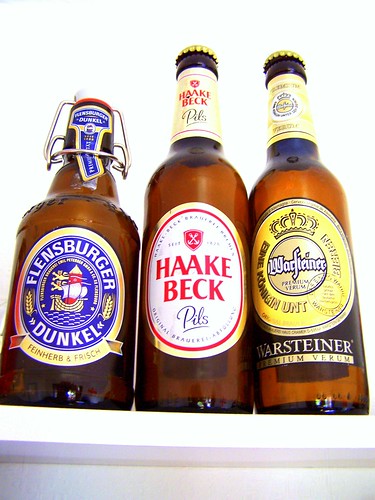
As reported yesterday, German beer prices are on the rise as more German farmers are growing biofuel crops rather than barley and hops.
Last night my dad told me that Paul Harvey reported that Mexican farmers are burning their blue agave, which is used for tequila, in order to keep up with US demand for corn/ethanol.
(interesting sidenote on the generation gap – I go to the web and blogs for my news, my dad gets most of his from Paul Harvey)
From Treehugger/Reuters:

The switch to corn will contribute to an expected scarcity of agave in coming years, with officials predicting that farmers will plant between 25 percent and 35 percent less agave this year to turn the land over to corn. “Those growers are going after what pays best now,” said Ismael Vicente Ramirez, head of agriculture at Mexico’s Tequila Regulatory Council….
Many growers have started to abandon the crop in favor of corn, whose price has rocketed in line with massive growth in U.S. demand for ethanol after President Bush outlined targets last year to use the corn-based fuel as a gasoline alternative.

All this talk of ethanol reminds me of a great episode from the West Wing – “King Corn.” Mmm the West Wing. Can television get any better?
With all the rush to make alternative fuels – why don’t we just burn beer and tequila in our cars ;-)?
I had a friend use everclear in his motorcycle once. He was short on gas money. He said it ran amazing for two full days. Even shot fire out the tailpipe when he accelerated fast.
The downside was it ran so clean and hot that it froze his entire engine up by the end of the second day.

Check MSNBC for more coverage

Biofuels make for increased beer prices

German Beers | Photo by starscream

Say it ain’t so?!

According to Treehugger, German subsidies for biofuel crops are decreasing the supply of crops like barley and hops, which naturally increases the price of the crops used in beer, which in turn increases the price of German beer.

In Germany, recent subsidies for biofuel crops have had an effect of the price of a dietary staple: beer. According to the Associated Press, many German farmers are now growing crops like rapeseed and corn rather than barley, and that shift is being felt at the tap…

From the AP:

In the last two years, the price of barley has doubled to euro200 (US$271) from euro102 per ton as farmers plant more crops such as rapeseed and corn that can be turned into ethanol or bio-diesel, a fuel made from vegetable oil.

As a result, the price for the key ingredient in beer — barley malt, or barley that has been allowed to germinate — has soared by more than 40 percent, to around euro385 (US$522) per ton from around euro270 a ton two years ago, according to the Bavarian Brewers’ Association.

For Germany’s beer drinkers that is scary news: their beloved beverage — often dubbed ‘liquid bread’ because it is a basic ingredient of many Germans’ daily diet — is getting more expensive. While some breweries have already raised prices, many others will follow later this year, brewers say.

(Photo by Starscream)

Vatican going green

Via DMN’s Religion Blog:

Solar panels – hundreds of them – are to be installed on one of the buildings. Here’s a story from Catholic News Service:

By CAROL GLATZ and ALICIA AMBROSIO
Catholic News Service

VATICAN CITY. Expanding its mission from saving souls to saving the planet, the Vatican is going green.

A giant rooftop garden of solar panels will be built next year on top of the Paul VI audience hall, creating enough electricity to heat, cool and light the entire building year-round.

“Solar energy will provide all the energy (the building) needs,” said the mastermind behind the environmentally friendly project, Pier Carlo Cuscianna, head of the Vatican’s department of technical services.

And that is only the beginning. Cuscianna told Catholic News Service May 24 that he had in mind other sites throughout Vatican City where solar panels could be installed, but that it was too early in the game to name names.

Even though Vatican City State is not a signatory of the Kyoto Protocol, a binding international environmental pact to cut greenhouse gases, its inaugural solar project marks a major move in trying to reduce its own so-called carbon footprint, that is, the amount of carbon dioxide released through burning fossil fuels.

The carbon dioxide-slashing solar panels will be installed sometime in 2008 after prototypes, environmental impact reports and other studies have been completed, Cuscianna said.

In a May 23 article in the Vatican newspaper L’Osservatore Romano, Cuscianna wrote that safeguarding the environment was “one of the most important challenges of our century.”

The Italian engineer said appeals by Popes Benedict XVI and John Paul II to respect nature inspired him to help power the Vatican’s energy needs with renewable resources.

He recalled how, in his 2007 World Day of Peace message, Pope Benedict warned of “the increasingly serious problem of energy supplies” that was leading to “an unprecedented race” for the earth’s resources.

Cuscianna also found inspiration from Pope John Paul’s 1990 peace message, dedicated in its entirety to the need to respect God’s creation.

“We cannot continue to use the goods of the earth as we have in the past,” the pope wrote, calling for “a new ecological awareness” that leads to “concrete programs and initiatives.”

Cuscianna took the initiative and helped draw up and deliver to the Vatican governor’s office a feasibility study of going solar.

He said the Paul VI hall was chosen first for a number of reasons: Cooling and heating the large audience hall makes it one of the top energy guzzlers in the Vatican, and its roof was in need of repair.

When the project is finished, more than 1,000 solar panels will cover the football field-sized roof.

While not revealing how much the solar project will cost, Cuscianna said “it will pay for itself in a few years” from the savings on energy bills.

Whatever solar power the hall is not using will be funneled into the Vatican’s energy grid and benefit other energy needs, he said.

The solar rooftop garden is not the first environmental project the Vatican has undertaken. In 1999, as part of preparations for the jubilee year, the entire lighting system of St. Peter’s Basilica was upgraded to be low-impact. Strategically placed energy-saving light bulbs were installed inside and out, cutting the basilica’s energy consumption by an estimated 40 percent.

In 2000, the Vatican unveiled its own electric motor vehicle recharging station, where electric wheelchairs, scooters and cars could “tank up.”

Unfortunately, the idea of replacing polluting, gas-powered cars with a network of electric vehicles within the Vatican stalled. U.S. Cardinal Edmund C. Szoka, the former archbishop of car-capital Detroit, had pushed for the cleaner switch while he was head of the commission that governs Vatican City State.

Pope John Paul, however, regularly used an electric car at Castel Gandolfo toward the end of his pontificate when he was no longer able to move easily around the grounds.

Cuscianna said the Vatican has a commission that studies environmental issues and potential eco-friendly practices. Programs facilitating recycling, composting and waste reduction have not yet been established.

An expansion of the Vatican’s use of renewable energy resources would not only reduce its greenhouse gas emissions, Cuscianna said, “it could be a condition that makes Vatican City more autonomous” and less dependent on Italy’s power grid.

With Italian news headlines warning of yet another sweltering summer and potential power brownouts and blackouts, greater energy autonomy for the Vatican through the sun sounds like a cool idea.

05/25/2007
Copyright (c) 2007 Catholic News Service/U.S. Conference of Catholic

Amazing Flickr stats

Flickr was down for some maintenance last night. While they were out they posted some interesting stats about the online photo sharing portal:

  • We serve 12,000 photos a second at peak times — that’s 2,654,208,000 bits each and every second (8:20 PM)
  • We set an all-time upload record yesterday: 2,070,075 photos in 24 hours! (8:40 PM)
  • The Flickrverse has over 8.5 million registered members (9:00 PM)
  • Over 10 million unique tags have been added to photos on Flickr (9:20 PM)

Good news for Sally

Got a call from Jose tonight, the doctors have given Sally the OK to go home.
They are now just waiting for several machines to arrive at their house to aid Sally in her recovery.
In case you didn’t follow along, it was discovered on Mother’s Day that Sally had AVM and had to be rushed to Baylor Dallas and ended up having an emergency eight hour surgery to fix the blood vessels going to her brain as well as remove a blood clot that had formed.
After the surgery, the doctors said the surgery was a success but she would likely lose all eyesight in her left eye.
Two days later she was doing much better and seeing out of both eyes. But Monday of last week the doctors realized she was having trouble breathing and had to give her a tracheotomy to allow her to breathe after scar tissue formed in her throat from the vent she was on during and after surgery.
Now a little more than two weeks later, Sally is ready to come home. Praise God! She will likely need to have an additional surgery to remove the scar tissue, but the doctors are saying she might heal on her own without the surgery.
Her vision is still somewhat blurry but the doctors are now saying it will likely fully recover.
Another praise is that Jose and Sally have no health insurance – but according to Jose, praise God because someone through the hospital has promised the family they will take care of all the costs of the surgeries, hospital stay, medicines, machines and meds at home and anything Sally needs.
What an amazing God! What a way to make himself real to this family and our church.
What a mighty God we serve.
Please continue to keep the Perez family in your prayers. There are sure to be other needs as both Sally and Jose have been out of work the last two weeks.
Thanks again for all your prayers – God has heard them.